
THE APPROACH
How Resonant Acting Works
At The Resonant Actor, the goal is not to train actors to perform behavior. The goal is to help actors experience the scene through the character’s mind.
When the character’s thinking is driving the moment, behavior becomes truthful and spontaneous. The performance does not need to be manufactured, and questions like “maybe I could be angrier here” often fall flat. The anger must grow naturally out of the character’s experience.
This approach begins with a simple shift in awareness. Instead of concentrating on how a line should sound or what emotion should appear, the actor focuses on what the character is thinking and experiencing in the moment.
When the thinking is real, the performance becomes real.
Thinking as the Character
The central skill actors develop in this work is the ability to think as the character while speaking the line.
Many actors remain partly focused on themselves during a scene. They may be wondering whether they sound believable, whether the emotion is clear, or whether the scene is working.
In resonant acting, that awareness shifts. The actor becomes only vaguely aware of themselves while the character’s thoughts drive the moment. In resonant acting, a simple principle guides the work: The actor provides the body and voice. The character provides the mind.
When that shift happens, the audience is no longer watching a line delivery. They are watching a living mind.
Thought → Emotion → ActionCreates Emotion
One of the core principles of this work is that thought leads to emotion, and emotion leads to behavior.
Actors are sometimes trained to begin with emotion or external behavior. But emotion becomes much more truthful when it grows from the character’s thinking.
A typical sequence looks like this:
I listen
I interpret what that means to me (the character)
The meaning lands internally
Emotion shifts
My behavior changes
Then I speak
In performance these steps happen almost instantly, but they are all driven by the character’s thinking.

How This Connects to Other Acting Techniques
Across many acting traditions, actors hear similar goals.
Be truthful.
Live in the moment.
Listen and react.
Don’t act, just be.
These ideas describe the result of strong acting, but they can sometimes feel abstract. Actors may understand the goal but still wonder how to reach it.
At The Resonant Actor, the work begins with the character’s thinking.
When the actor is actively thinking as the character, many familiar techniques begin to fall into place.
Objectives become clear because the character knows what they want.
Beats shift when the character has a new thought.
Emotional stakes appear because the character understands what could be lost.
Instead of trying to manufacture emotion or behavior, the actor focuses on the character’s experience of the moment.
From that thinking, emotion, behavior, and performance begin to emerge naturally.
When the thinking is clear, the technique begins to organize itself.
What Changes For Actors
Actors who begin working this way often notice a shift in their performances.
Instead of trying to control how a line sounds or forcing emotion, the actor’s attention moves into the character’s thinking. From that point, many parts of acting that once felt difficult begin to organize themselves.
Actors often find that:
• lines feel easier to speak naturally
• emotions appear without being forced
• listening becomes more active and responsive
• reactions feel more spontaneous
• performances feel calmer and more grounded
• auditions become clearer and more confident
The actor is no longer trying to perform the scene.
They are living inside it.
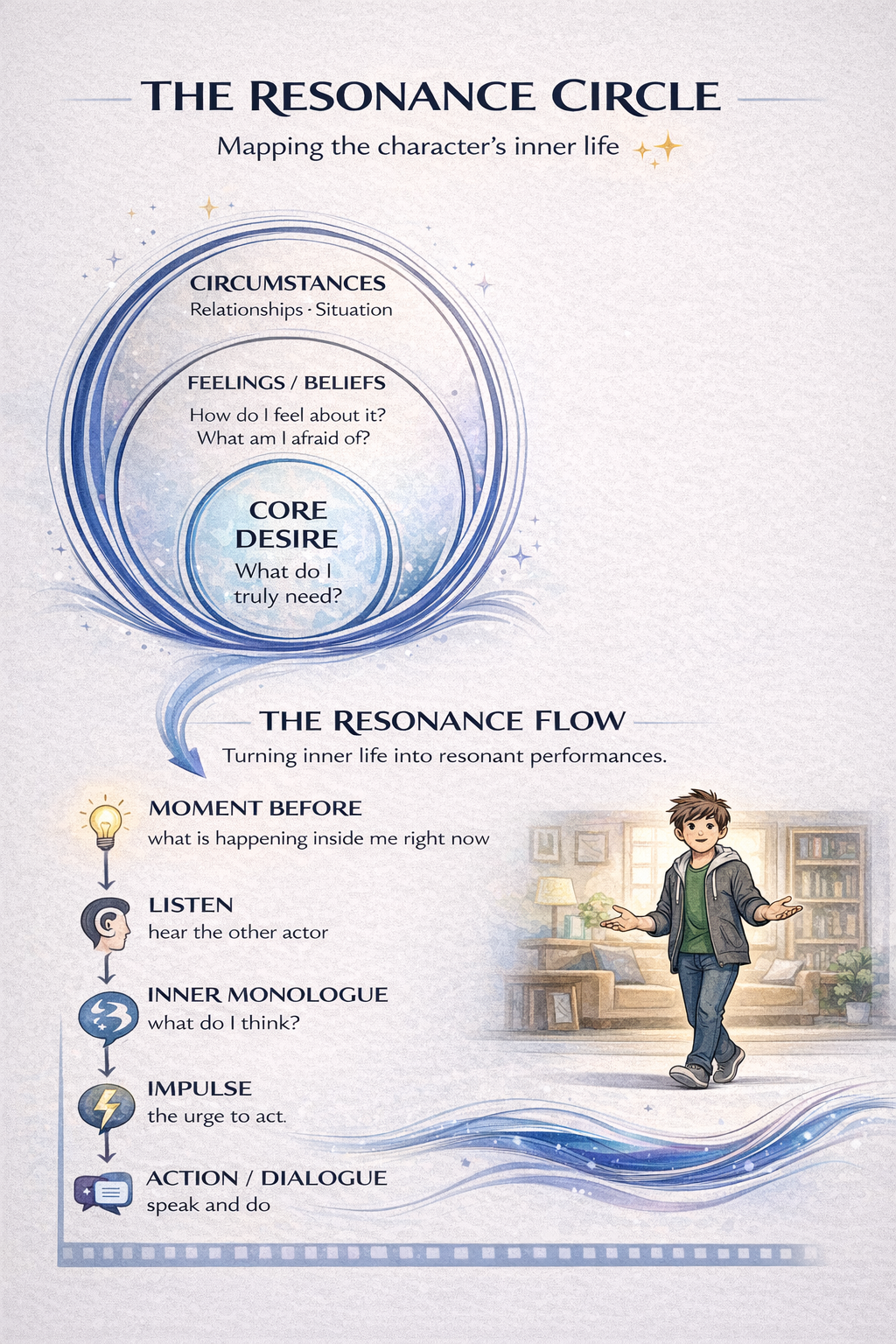
The Resonance Circle
One of the tools used in this work is called the Resonance Circle.
The circle helps actors map the character’s inner life in layers.
The outer ring contains the character’s circumstances and relationships.
The middle ring explores beliefs, fears, and desires.
The center reveals the character’s core need.
By identifying the forces that live inside the character, actors begin to understand what thoughts are driving the scene.
From this work we often discover the character’s loudest thought entering the moment. That thought becomes the moment before and fuels the actor’s inner monologue.
Acting Happens Quickly
Although actors train with many tools, the experience of performance happens very quickly.
Listening, thinking, reacting, and speaking often occur within a fraction of a second.
Preparation allows these responses to happen naturally and instinctively.
When the actor is fully engaged in the character’s mind, the scene begins to unfold on its own. The performance feels spontaneous because the behavior is emerging from real thinking.
The Techniques
These tools help actors move from analyzing the script to actively thinking as the character during the scene.
The Moment Before
Scenes do not begin at zero.
Every character enters a scene carrying something with them. They have just come from somewhere, something has just happened, and a thought or feeling is already active.
The moment before identifies the state the character is in just before the first line.
What just happened?
What is already true in the character’s mind and body?
What thought is most alive right now?
Sometimes the moment before is dramatic or emotionally charged. Other times it is completely ordinary. A character may simply be arriving, thinking about something mundane, or moving through their day when the events of the scene begin to unfold. In those cases, the scene itself becomes the moment that changes the character.
What matters is that the actor understands what state the character is in when the scene begins.
That thought becomes the ignition point of the scene. It creates urgency, emotional temperature, and direction before the actor even speaks.
When the moment before is clear, the actor enters the scene already living as the character rather than trying to act their way into the moment.
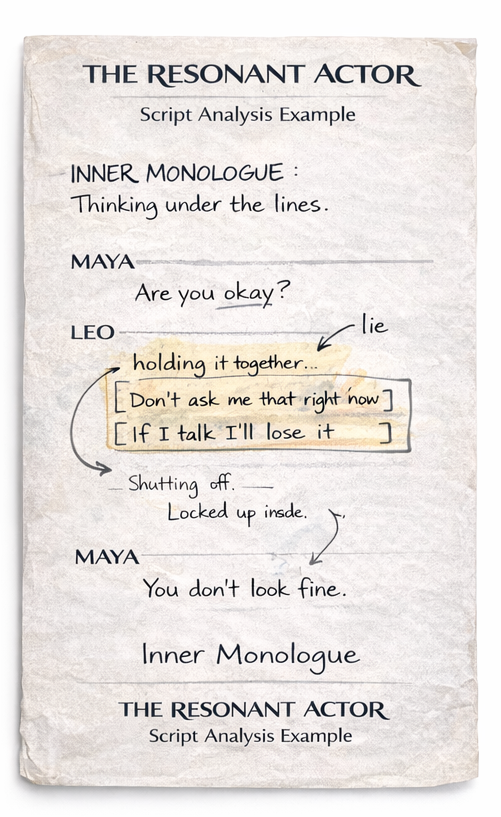
Inner Monologue
Human beings are constantly thinking. Our characters should be as well.
Inner monologue is the character’s ongoing stream of thought while the actor is listening, reacting, and speaking.
These thoughts may include reactions to the other character, interpretations of what was said, judgments, worries, hopes, or things the character wishes they could say but cannot.
Without inner monologue, many actors fall into the habit of going blank between lines — waiting for the next cue instead of actively experiencing the scene.
Inner monologue keeps the actor mentally alive inside the moment. The character continues thinking while listening, while reacting, and even while speaking.
Most importantly, it allows the actor to think as the character while saying the line. The line does not replace the thought.
The line comes from the thought.
Acting the Song
Songs in musicals are not separate from the character’s thinking. In many ways, a song is simply the character’s inner monologue becoming audible.
In a musical, characters often sing when their thoughts and emotions become too strong to remain unspoken. The song allows the audience to hear what the character is thinking, feeling, and struggling with internally.
Actors working on songs can apply the same tools used in scene work:
• script analysis of the lyrics
• character perspective
• inner monologue between phrases
• the moment before the song begins
• listening and reacting within the scene
When actors treat the lyrics as thoughts rather than performance, the song becomes grounded in character experience instead of presentation.
Instead of asking “How should I sing this line?”, the actor asks:
“What is my character thinking that makes them need to sing this?”
When the thinking is clear, the song becomes truthful, specific, and dramatically alive.
The Goal of the Work
The goal of this approach is not to create bigger emotions or more dramatic performances.
The goal is to create truthful internal life.
When the actor is thinking the character’s thoughts, listening carefully, and responding in real time, the performance begins to resonate.
The audience senses that something real is happening underneath the words.
They are not watching an actor perform a character.
They are watching a mind at work.